

Copper’s paradox indicates the market’s long-term focus
Despite global copper inventories rising to 1.1 million metric tons, the most in 23 years, prices have reached unprecedented highs this year caused by robust demand from hyperscale projects and supply disruptions at major mines in late 2025.
BHP Group and Rio Tinto, two major miners, reported better-than-expected half-year copper production results. This is mainly due to increased stockpiling by the United States and global supply disruptions. However, analysts claim securing long-term copper deposits will be challenging and costly for miners.
The big picture: This contradiction between inventory levels and prices suggests the copper market is looking past the current supply surplus in favor of a projected long-term deficit. This future deficit is driven by the critical need for copper in AI and related projects and supply shortages from mines and smelters.
Copper prices rose as high as 2.8% on the London Metal Exchange (LME) in late February. This was driven by the reopening of Chinese markets after the Lunar New Year holiday and bolstered by investor optimism after the U.S. Supreme Court ruled that President Trump’s use of the International Emergency Economic Powers Act (IEEPA) to impose tariffs was unlawful.
Why it matters: China faces lower U.S. tariffs following the court’s decision that eases pressure on its exporting industry and after the Trump administration imposed a 10% global tariff in response to the Supreme Court ruling.
Yes, but the U.S. Supreme Court’s decision does not affect copper, steel and aluminum tariffs imposed under a separate authority — Section 232 of the Trade Expansion Act of 1962, and they remain in effect.
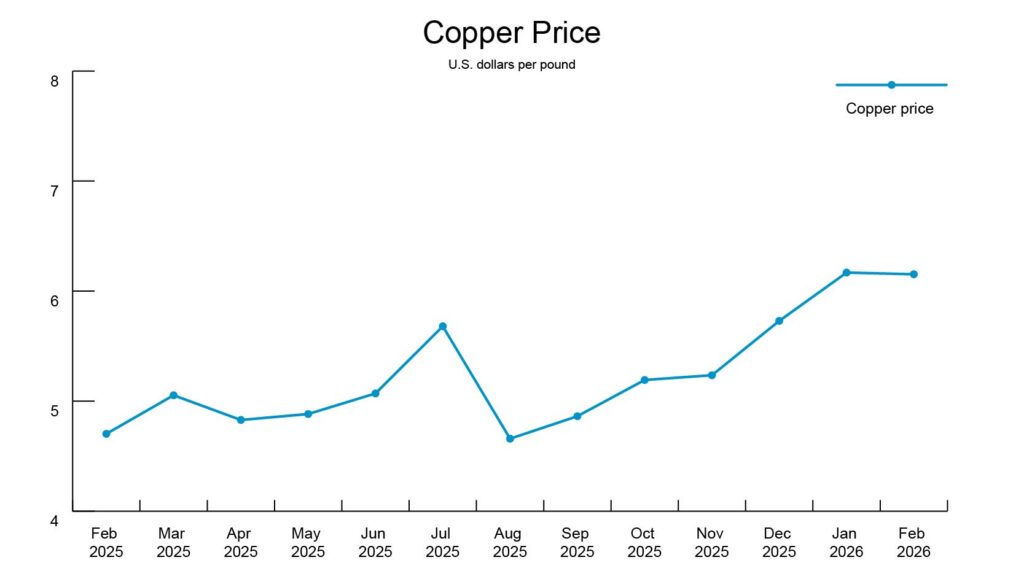
Copper prices on the Comex have been hovering around $5.90 per pound for the past week. This morning, copper opened at $5.69.

Aluminum prices surge due to escalating conflict in the Middle East
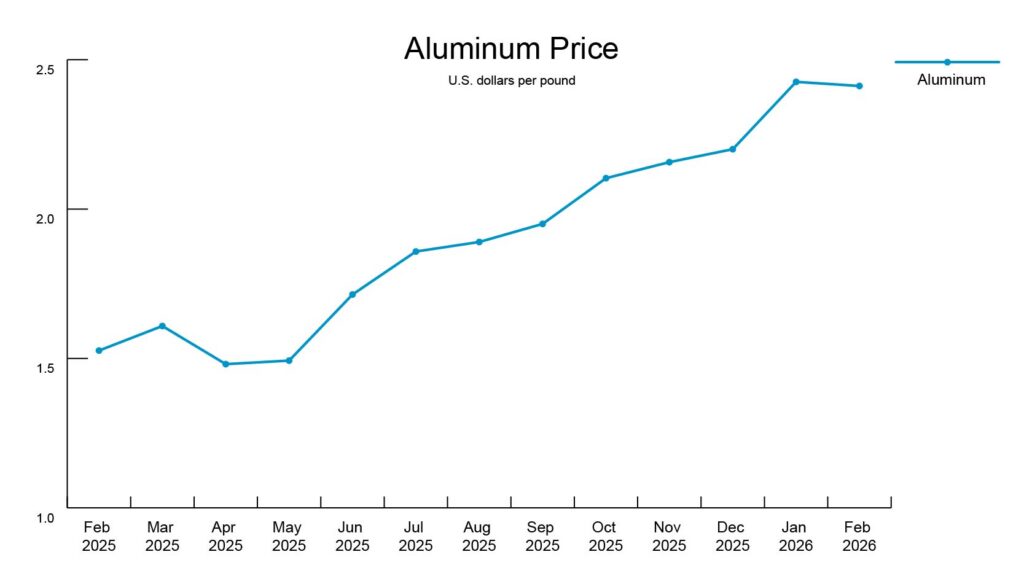
Benchmark aluminum prices reached a new high on the LME for the year, rising 1.7%, driven by concerns over supply disruptions due to the escalating conflict in the Middle East.
Why it matters: The Middle East accounts for approximately 9% of global aluminum production and one-fifth of the production outside of China. Bahrain, United Arab Emirates and Saudi Arabia are major aluminum suppliers. The conflict could disrupt critical routes, such as the Strait of Hormuz, supply chains including transport and insurance costs, and impact production throughout the region. As a result, aluminum withdrawals from inventory warehouses have doubled.
The big picture: Conflict in the Persian Gulf often increases oil and natural gas prices, which, in turn, can raise global aluminum production costs.
Zoom in: The Strait of Hormuz is a key shipping lane and could become a chokepoint. If conflicts restrict shipping in the region, raw materials and finished metals, such as aluminum rods, which are crucial to electric utilities and construction projects, could experience price volatility and supply chain disruptions.
Midal Cables, a major aluminum manufacturer based in Bahrain, faces potential disruptions because it nearly exclusively utilizes the Strait of Hormuz. If the regional conflict spreads or affects shipping lanes, Midal’s exports could slow, and aluminum prices could see increased volatility. Some, though not all, U.S. wire and cable manufacturers source some aluminum rods from Bahrain.
By the numbers:
- Finished aluminum goods will see a 7% to 10% increase March 9. This could cascade to domestic producers of 1350 aluminum alloy, affecting volume and availability.
- Aluminum prices on the LME climbed to a one-month high, as much as 3.8% on March 3, after a key producer in the Middle East halted aluminum production in the region due to supply risks.
- The U.S. Midwest Premium (MWP) for aluminum continued its rise to record highs on March 1, surpassing $2,100 per ton in mid-February, fueled by the conflicts and the 50% tariff on aluminum imports, which is causing a disparity between domestic market prices and global benchmarks.
- Today, aluminum opened at $2.58.
The bottom line: Conflict involving Iran would likely increase aluminum rod prices, disrupt supply chains and create shipping risks, but it would not necessarily stop production unless the conflict escalates across the Persian Gulf. Experts say the scale of any potential supply disruptions depends on how long the conflict persists.
More aluminum news: Emirates Global Aluminum and Century Aluminum announced a joint development of a new aluminum production facility in Oklahoma — since 1980 — aiming to significantly boost domestic production.

Steel pipe increased due to rising demand
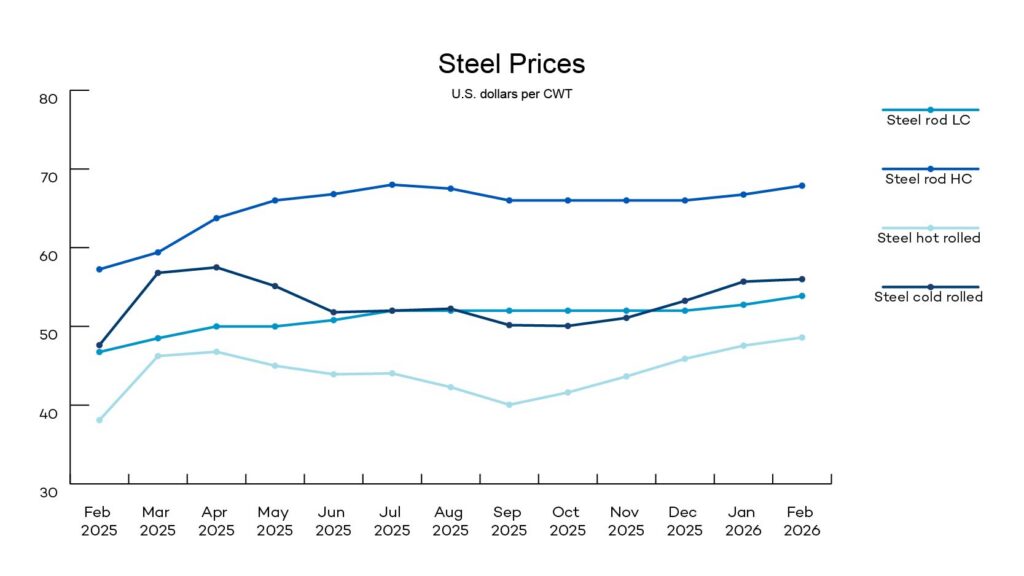
In early March, 3/4-inch steel pipe saw a 7% to 10% price increase nationally.
Why it matters: The price increase was driven by higher demand from data centers and the ramp-up to the spring construction season. Price increases typically occur to control demand and build inventory.
By the numbers: According to the American Iron and Steel Institute, in the week ending February 28, domestic raw steel production saw a 6.2% increase from the year prior, with a slight dip from the previous week. The year-to-date production through February 28 rose 5% from the previous year; capability utilization rate also increased.
More steel news:
- Europe’s steel industry is urging the European Union to ensure its upcoming Industrial Accelerator Act, which mandates prioritizing locally made materials for projects funded with public money, to include steel and define “local” as EU-member neighbors, like Great Britain and Norway.
- Steel startup U.S. Forged Rings announced a major investment in North Carolina for its new manufacturing facility, where it plans to expand the domestic production of critical steel components to serve the industrial sector.

The PVC market saw an increase in early March
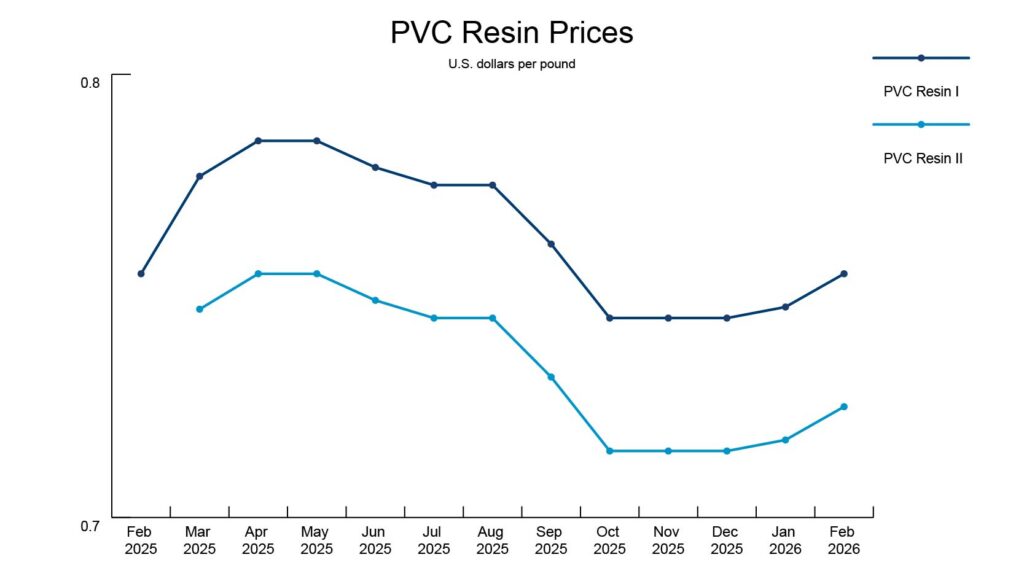
The PVC market saw a 7% to 10% price increase in early March, and resin saw a 1% price increase in February.
The resin market is expected to grow by nearly 5% by 2035, driven by demand in the packaging and automotive industries.
Why it matters: The forecast highlights an increased reliance on lightweight and durable materials across a range of vital industries.
More PVC news: Suppliers report strong inventory levels, except for large-diameter pipes and special-radius bends, which have extended lead times.
News roundup
The Federal Reserve (Fed) Governor Christopher Waller said it was too soon to know how the recent Supreme Court ruling invalidating President Trump’s tariffs imposed under the IEEPA will affect inflation in the short term. In another interview, Waller said the Fed might hold off on another interest rate cut due to a strong January jobs report. Fed officials will meet on Tuesday, March 17, and Wednesday, March 18.