

Speculation over copper sends the metal on a price spiral
Copper prices tumbled from record highs on January 30 after weeks of speculation tied to who the Federal Reserve (Fed) chair nominee would be and the U.S. dollar’s movements.
Why it matters: The single-day spike was mainly driven by a wave of buying from investors in China, who expected prices to surge due to global demand from hyperscale projects like data centers, possible Fed chair nominee and the U.S. dollar weakening further. This led the total global inventories to reach more than 900,000 metric tons, a 23-year high.
Zoom in: Over the last two days in January, copper prices peaked above $14,000 per ton on the London Metal Exchange (LME), then fell to approximately $13,800 per ton after the Fed held interest rates and Trump announced Kevin Warsh as his pick to lead the Fed.
Between the lines: The growing competition for resources has countries looking to strategically secure their own metal stockpiles to reduce dependence on foreign supply.
- In the United States, President Trump recently announced a plan to create critical mineral reserves to protect domestic manufacturers against supply shortages and reduce reliance on China.
- The European Union is proposing a partnership with the United States to source critical minerals. Under the proposal, they would explore joint critical-mineral projects, price-support mechanisms and build secure supply chains to curb dependence on Chinese minerals.
- China’s metals industry association pushed for the country to expand its copper reserves to bolster supply security and reduce cost pressure on producers.
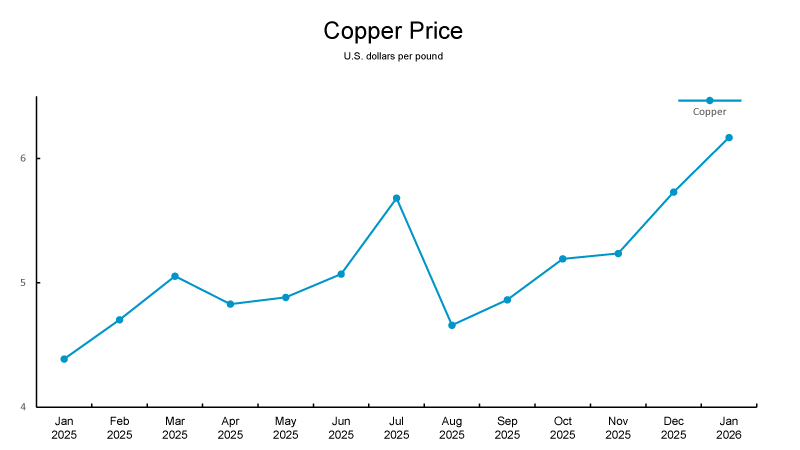
The bottom line: Despite these speculations, copper’s role in critical infrastructure, including AI and renewable energy, continues to drive robust demand, complicating predictions about its future prices. This morning, copper opened at $5.88.
More copper news: Major copper miners report sizable 2025 fourth-quarter production results.
- Rio Tinto reported an 11% increase in copper production in 2025, surpassing its own forecast. The company said it produced more than 800,000 metric tons, supported by rising production from its Oyu Tolgoi mine in Mongolia. Output in the fourth quarter was 5% higher year over year.
- Freeport-McMoRan reported better-than-expected results, as higher copper prices offset the production decline following a natural disaster incident at Indonesia’s Grasberg mine in September 2025. The company expects about 85% of production at Grasberg to be back online by the second half of 2026.

Aluminum’s Midwest Premium doubled since tariff took effect
The U.S. Midwest Premium (MWP), the regional price of aluminum in the Midwest, reached more than $1 per pound at the end of January.
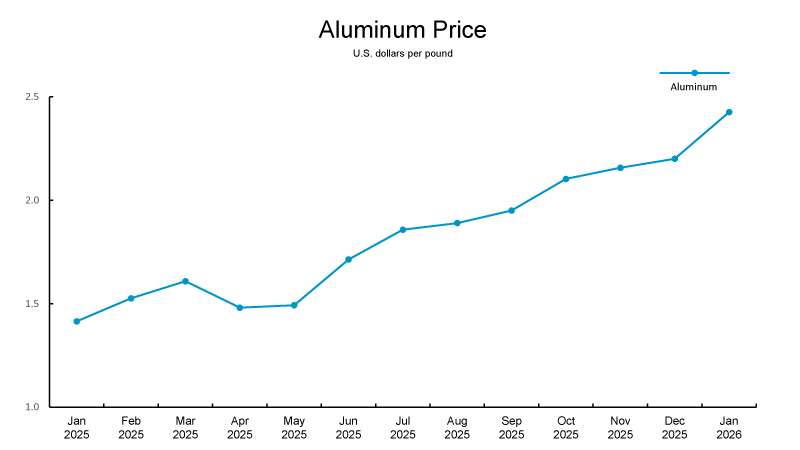
The big picture: The MWP is an additional cost added to the global benchmark price. Since President Trump imposed a 50% tariff on aluminum imports, in June 2025 the MWP has more than doubled, driving domestic prices to rise faster than international prices. Today, aluminum opened at $2.43.
Between the lines: As the dollar weakened in January, aluminum prices rose by up to 5.7% on the Shanghai Futures Exchange in China and to its highest levels in nearly four years on the LME.
Why this matters: Copper prices surged exponentially in the same timeframe. According to experts, once copper prices get too high, aluminum becomes a cheaper alternative to buy.
Aluminum producer Alcoa reported high fourth-quarter results after raising aluminum prices to offset tariff costs. It expects productivity improvements this year; however, sales gains were canceled out partially by lower average alumina prices and aluminum shipments.
Quick catch up: In February 2025, many producers, including Alcoa, worried that the 50% tariff on aluminum imports would affect job security and production costs in an industry with limited U.S. suppliers to meet demand.
More aluminum news: Aluminum Corporation of China and Rio Tinto have agreed to buy a majority stake in Brazilian aluminum producer, Companhia Brasileira de Aluminio, making a significant move toward low-carbon aluminum production.

Steel output in China slows, but export levels rise to a record high
China’s crude steel production output dropped to a seven-year low in 2025 due to a prolonged slowdown in domestic demand from the property market.
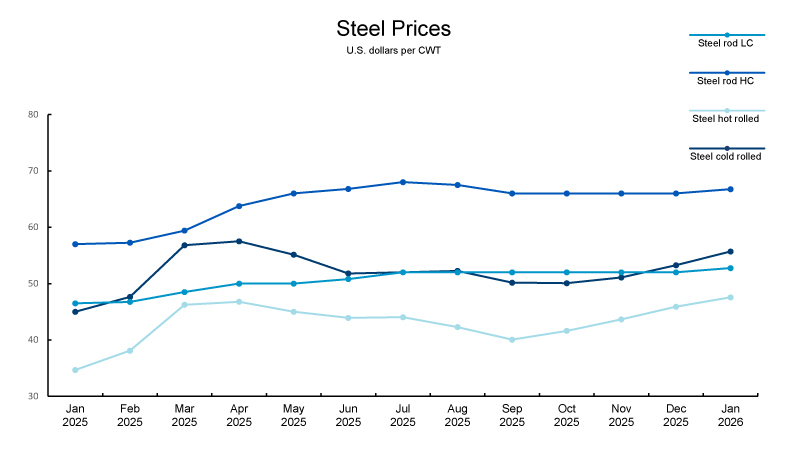
Why it matters: China is one of the world’s largest steel-producing nations. Its steel exports remained healthy at record levels despite facing trade restrictions in some countries. Data revealed production declined 4.4% from 2024. Profitability in 2025 has improved due to strong demand for flat-steel exports, such as hot-rolled coil. Analysts expect output to continue a slow decline in 2026.
Deep dive: In a recent panel, industry leaders gathered to discuss how U.S. trade policies — particularly steel tariffs — have evolved over the past years, and the implications for global supply chains and the health of the domestic industry.

PVC’s January-announced increases struggled to hold
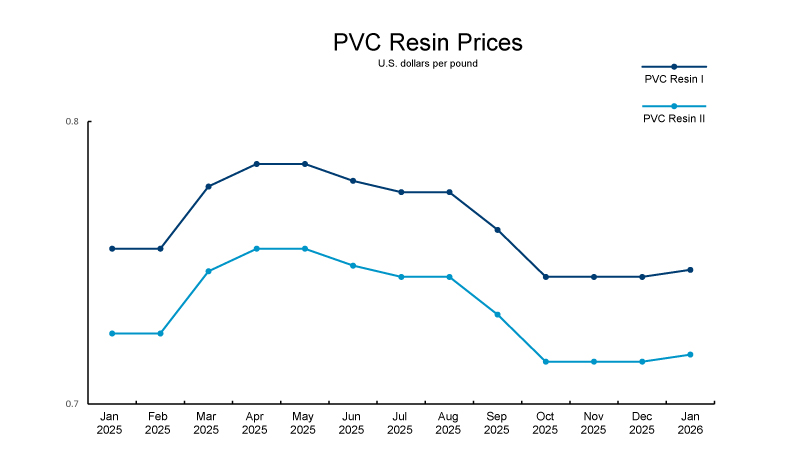
PVC suppliers continue to struggle to pass through price increases driven by demand from hyperscale projects. Price increases announced in January did not hold, but suppliers are attempting to implement more increases in February.
What’s next: The market will wait to see whether these increases stick. Certain suppliers are reevaluating pricing depending on the product.
What they’re saying: Suppliers report strong inventory levels aside from large-diameter pipes and special-radius bends, which have extended lead times.
News roundup
President Trump announced Kevin Warsh, former Fed governor, as his nominee to succeed Fed Chair Jerome Powell after his term ends in May. The Senate will need to confirm Warsh before he can take over the position. In the meantime, Warsh is expected to fill the Board of Governors position, which Stephen Miran temporarily held.
The Fed voted 10 to 2 to hold interest rates steady, keeping the benchmark federal funds rate between 3.5% and 3.75%, for the first time since July 2025. Fed Chair Jerome Powell noted recent data showed solid economic growth and tentative signs of a stabilizing job market. Officials will meet again Tuesday, March 17 and Wednesday, March 18.